
Responsible tourism is easy to claim and hard to verify. Booking pages use the phrase freely, yet the underlying idea is specific: travel decisions are judged by their effects on nature, on host communities and on the people who will travel after you. This guide turns that idea into choices you can make before you book, while you are away and once you are home.
- Responsible tourism weighs current and future economic, social and environmental effects, not only the footprint of one trip.
- Transport, plastic, waste and where your money lands are the decisions you control most directly.
- Every choice carries trade-offs in cost, convenience and carbon, and you are better off knowing them than ignoring them.
What does responsible tourism actually mean?
One practical definition describes it as a way of travelling that assesses the present and future economic, social and ecological effects of tourism, while taking into account the needs of travellers, the environment, the industry and host communities. Notice how many parties that list contains. The traveller is one of them, not the only one, and that is the key difference from a trip that is simply labelled green.
For decision-making, it helps to sort your choices into three pillars:
- Environmental impact: emissions, waste, plastic, water and energy use.
- Economic fairness: whether a fair share of the money stays with local people and businesses.
- Cultural respect: whether local skills, traditions and ways of life are protected rather than turned into a backdrop.
A related term, sustainable tourism, covers the whole tourism experience and combines concern for economic, social and environmental issues with attention to the traveller’s experience and the needs of host communities. In everyday booking language the two terms overlap heavily. What matters for you is the test they share: does this choice reduce harm and leave something positive behind?
Keep that test in mind when reading any listing. A claim that mentions only one pillar, usually a reusable-bottle policy or a towel card, is a partial answer at best.
How do you tell real responsible tourism from sustainability marketing?
The concept itself is slippery. Sustainable tourism has been described as an exceedingly complex concept with varied definitions, because it grows out of sustainable development, a term open to wide interpretation. That looseness is exactly what marketing exploits, so your best defence is to ask for specifics.
Use these checks before you commit to a provider:
- Look for named practices, not adjectives. A description that explains how waste is handled, where energy comes from or who owns the business tells you more than words like green or eco-friendly.
- Check all three pillars. A lodge with a strong energy story but no mention of local employment or ownership is covering one-third of the idea.
- Ask who benefits. Ecotourism, at its core, means running a tourism business so that a fair share of the profit stays locally while the ecological effect is kept low.
- Expect measurable claims. A provider that tracks water, waste or emissions can usually tell you something concrete when asked.
- Be wary of vague totals. Statements such as carbon neutral or zero impact deserve a follow-up question about how that was reached.
A short email asking how a business handles waste, whom it employs and where its food comes from is a fair test. Operators who take responsible tourism seriously tend to answer clearly. Those who rely on branding tend to reply with more branding.
Which transport choices matter most?
Transport is usually the largest lever you have. Fossil-fuelled transport is a major source of greenhouse gas pollution, and it also produces smog and other air contamination. Cutting transport emissions is widely described as one of the most important steps in tackling the climate crisis, which is why it sits at the top of any responsible trip plan.
Your practical options, roughly from the most to the least demanding:
- Choose a closer destination. The shortest trip you can enjoy is often the lowest-impact one.
- Take the train where a rail route exists. It also changes the character of the journey, since the travel itself becomes part of the trip.
- If you must fly, compare flights. Where options exist, pick the flight with the lowest CO2 emissions on offer.
- Move around on arrival by foot, bicycle and public transport rather than private cars.
The carbon footprint of a trip is the total greenhouse gas emissions linked to producing, using and disposing of a product or service. That includes carbon dioxide, but also methane, nitrous oxide and fluorinated gases, which trap heat. For a traveller, the lesson is that a footprint is not only the flight. Food, accommodation and daily movement all add to it.
The honest trade-off: slower modes usually cost more time and sometimes more money, and they are not available on every route. Choosing one fewer long-haul trip may do more than any number of small habits on the ground. Treat it as a decision to weigh, not a rule to obey.
How do you choose accommodation and manage waste on the road?
Accommodation sets the baseline for your daily impact. An eco-conscious place is one that builds sustainability into its business practices, with a clear focus on reducing carbon emissions, water use, waste and electricity consumption. Many are built from sustainable materials and aim for a low or zero carbon footprint.
When comparing places to stay, look for answers to these questions:
- Does the property explain what it does with water, energy and waste, rather than only that it cares?
- Are the staff and the suppliers local?
- Does it offer refill points or filtered water instead of selling bottled water?
- Are the building materials and the style of the property in keeping with the area?
Plastic deserves special attention. Single-use plastics such as straws, bags and bottled water are among the most damaging items for the environment, and plastic does not break down. Reducing it takes planning rather than sacrifice:
- Carry a refillable bottle, ideally one with a filter if tap water is doubtful.
- Bring a small bag for your own rubbish and for shopping.
- Refuse plastic straws and pack reusable cutlery and a container if your itinerary involves a lot of takeaway food.
The same logic applies to the wider idea of zero-waste travel, which is about effort more than perfection. Going paperless, packing toiletries in reusable containers and packing light all help. Be realistic about what a given destination allows: where waste collection is weak, avoiding disposable items matters even more, because the local system may be unable to absorb what you leave behind.
Where should your money and your attention go?
Economic fairness is the pillar travellers most often overlook, because it is invisible at the moment of purchase. Yet spending is the most direct way a visitor affects a community. Buying local crafts, for example, has a real effect on the local economy, and craft tells the story of a place and its people while keeping traditional skills alive. Those skills are worth protecting by rewarding the people who practise them, particularly when the objects are made from sustainable or environment-friendly materials.
Habits that move money in the right direction:
- Buy souvenirs from the people who made them rather than from generic shops stocking imported goods.
- Eat at locally owned places and shop at farmers’ markets and grocery stores for local and organic products where possible.
- Book guided excursions with operators who are based locally, and ask who the guides are and how they are paid.
- Pay a fair price. Aggressive bargaining over small sums rarely helps the person across the table.
Cultural respect follows from the same attitude. Informed visitors help host communities to value their own history and heritage, while communities educate visitors in return. In practice, this means learning something about local customs before arrival, asking before photographing people, and treating a place as someone’s home rather than a stage set.
Trade-offs exist here too. Locally owned options are sometimes less polished and harder to book than international chains, and you may need to plan further ahead. That inconvenience is often the visible sign that the money is reaching the right hands.
A practical checklist: before, during and after your trip
Responsible tourism becomes manageable when you split it into stages. The lists below gather the points above into one reference you can adapt to any destination.
Before you book
- Decide whether a nearer destination or a train journey could meet your goal.
- If you fly, compare options and favour the lowest-emission choice available.
- Ask accommodation and tour providers specific questions on waste, energy, local employment and ownership.
- Pack light, along with reusable bottle, bag, cutlery and containers.
During the trip
- Walk, cycle or use public transport on arrival.
- Refuse single-use plastic and fill your bottle where you can.
- Spend with local businesses, and buy crafts from those who make them.
- Follow local customs and ask before photographing people.
After you return
- Note which choices cost you little and which were hard, so the next plan improves.
- Return to the places and providers who treated people and place well, since repeat visits help local businesses.
- Share specific recommendations with other travellers instead of general praise.
Finally, keep expectations realistic. No trip scores perfectly on all three pillars, and cost, convenience and carbon will sometimes pull in different directions. What the practice asks of you is attention: to know the trade-off, make the better available choice, and ask providers to do the same.
Related reading
- Cycling the Danube From Passau to Vienna: A Low-Impact Week
- Volunteer Tourism: The Questions to Ask Before You Pay to Help
Sources
- Responsible Tourism – A guide to sustainable travel practices (trickytravellers.com, accessed 2026-11-23)
- Sustainable tourism — Wikipédia (en.wikipedia.org, accessed 2026-11-23)
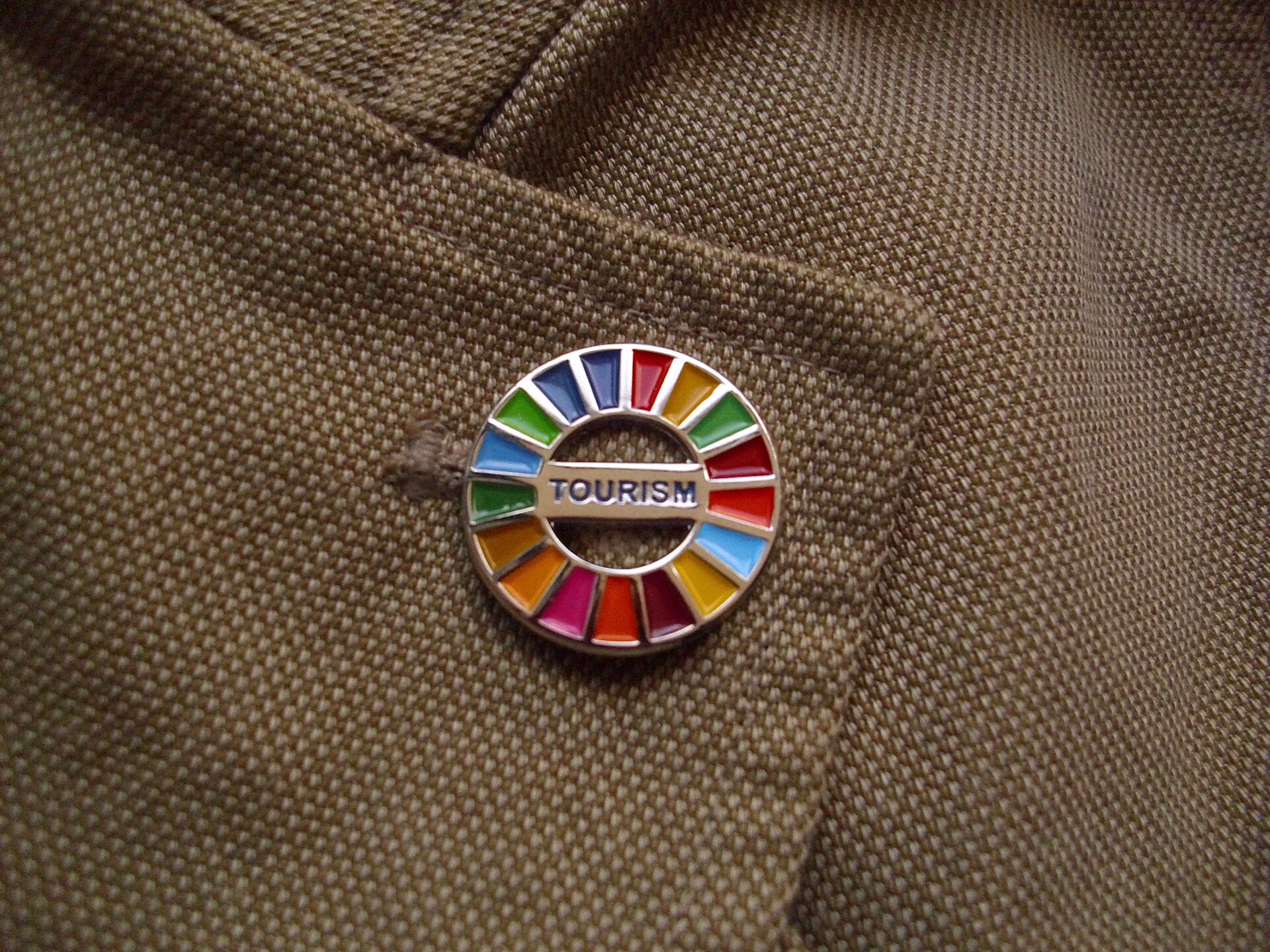
Photo: Sustainable Tourism – SDGs badge by UNWTO, by Indiana jo, CC BY-SA 4.0 (Wikimedia Commons)
